There was no particular reason for it — I’d never touched math modeling — I was simply invited to the MCM on short notice. I skimmed how the contest worked, felt it was a decent fit for my tech stack, and said yes. Fully aware that the result would do almost nothing for my grad-school applications, I barely prepared beforehand: a rough search of the contest’s usual playbook and other people’s debriefs, and then straight in.
We started out with a just-happy-to-be-there attitude, and since both of my teammates were on campus and could meet in person, I slept in past nine on day one. (Though on day four I was at it until past nine in the morning.)
While eating an Egg McMuffin I saw this year’s translated problem set on Zhihu. A was clearly some ODE-plus-cross-discipline thing — unnerving at a glance; B was a space-tech topic, suspected multi-objective optimization; C was data-cleaning, boring enough to discard on sight; D was sports I don’t understand — discarded on sight; E looked somewhat interesting, but I didn’t get it, worth another look; F was pure nonsense — discarded on sight.
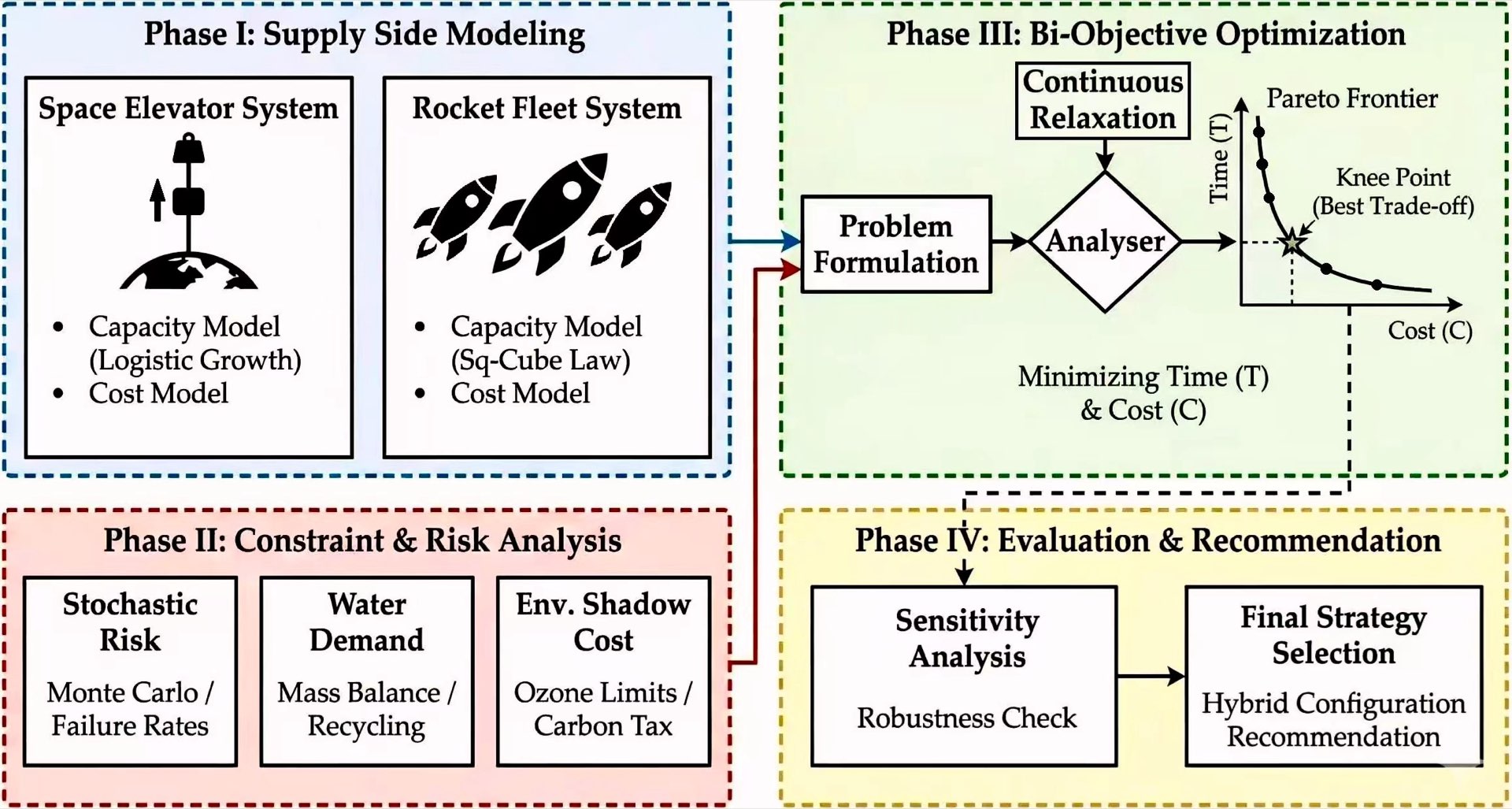
An hour or two of casual discussion and searching with my teammates, and we settled on Problem B around noon — in hindsight, a good choice. A and E crossed into fields we genuinely weren’t familiar with, while for B I and one other teammate had taken optimization-related courses, and my EAP essay had happened to be a polemic against SpaceX.
Timeline
Day 1
Mostly discussion (chatting). Problem B is an extremely vague prompt; we ran a reasonably efficient brainstorm plus all sorts of discussions over which assumptions were reasonable, settled on a framework, and called it a day. Since my teammates and I all happened to have other real-life things going on that day, we didn’t get much done — excusable. The good news: not much energy spent.
Day 2
The least efficient day. After finishing the assumptions I started writing the first half of the paper and building the most fundamental optimization models. But the model research on my teammates’ side stayed inefficient — the discussion dragged on past nightfall without ending. Since this piece was the base numbers for every later task, nothing downstream could move until it was done. One chunk of the rocket I couldn’t stand it anymore, so on day-three afternoon I force-cut it, took over, and finished in a blitz. That night I knew full well we were severely behind baseline; I worked until five a.m. integrating part of the raw material into the paper.
Day 3
More or less back on track. After wiping up the earlier messes in the afternoon, I finished task 1 in three hours that evening. The two teammates were simultaneously doing research and numerical modeling for the later tasks. Whether it was experience kicking in, or having my earlier writing as a corpus to imitate, the work quality jumped several tiers at once — from a projected pace that couldn’t finish at all to something with real hope.
Day 4 / 4.5
Day four was a super siege. We didn’t start working until about eleven, since we knew tonight was the all-nighter and let ourselves rest a bit longer. I spent some three or four hours finishing task 2, plus a little time adjusting all the earlier work to make it more coherent. Pleasant surprise: when I was about to start task 3, I found my teammates’ work was remarkably complete — with only minor tweaks from me it was ready to use. The remaining tasks then went down smoothly. By around two a.m. the paper’s main body was basically done; time for the polish and the summary. One final hour went into compressing everything under 25 pages, and I submitted just past eight — riding right up against the DDL.
Reflections
What Went Well
The brainstorm for Problem B was necessary, and we did it well — in hindsight it saved us a lot of trouble.
Establishing my autocratic position on day one — maybe that’s where our later efficiency came from.
To be efficient, this contest should be played in person: problems get discussed face to face, no time wasted on inefficient online communication.
Thanks to cra for the free Overleaf service, which freed us from version-drift and merge-mess worries.
What Went Wrong
Severe early inefficiency. Two problems, I think: the first came from me — my search targets were too vague, so what I wanted and what my teammates brought back diverged wildly; the second came from my teammates over-relying on AI search without filtering the information or organizing it sensibly, which wasted a lot of time.
Still not enough time left for polish and layout. At the very least, the time left wasn’t enough for me to unleash my full repertoire, and it never got buffed to a truly finished state — a bit of a pity, I think.
Closing Words
First MCM, and also my last. If you treat it as a curiosity-seeking experience, it was overall fairly pleasant.
There was still a small sense of accomplishment at the finish. Did I learn anything new? Not really — I just re-ran the playbook accumulated from earlier courses and research; it was purely a run on accumulated stock. The biggest gain was maybe the leadership experience…
Post-Contest Update
Meritorious Winner, exactly as I had expected. Barely enough to add one line to the résumé — its actual significance remains dubious — but a gain is a gain.
Stay tuned!